
On April 14, 2025, the Chinese Ambassador to The Bahamas Her Excellency Ms. Yan Jiarong, published an article entitled "Uphold International Rule and Order for a Stable and Prosperous Future" in The Tribune. The article exposes the destructive nature of the U.S. so-called "reciprocal tariffs" policy, emphasizing that intimidation, coercion and threats never work with China. Taking necessary countermeasures and standing up against power politics is not only about safeguarding China's legitimate rights and interests but also about upholding international rules and order, protecting the common interests of nations worldwide. The Chinese people will not yield to coercion or bullying, remaining confident, composed, and focused on managing their own affairs well. The Chinese people stand very much united with strong determination to overcome all Challenges, promoting high-quality development to a higher level.
The article highlights that the U.S. abuse of tariffs has severely disrupted the world economic order and is deeply unpopular. China's economy, with its solid foundation and strong resilience, is fully capable of meeting the challenges of unilateralism and protectionism. China will continue to serve as an "anchor of stability" for the multilateral trading system. The article calls on Global South countries to jointly oppose tariff and trade bullying.The full text is as follows:
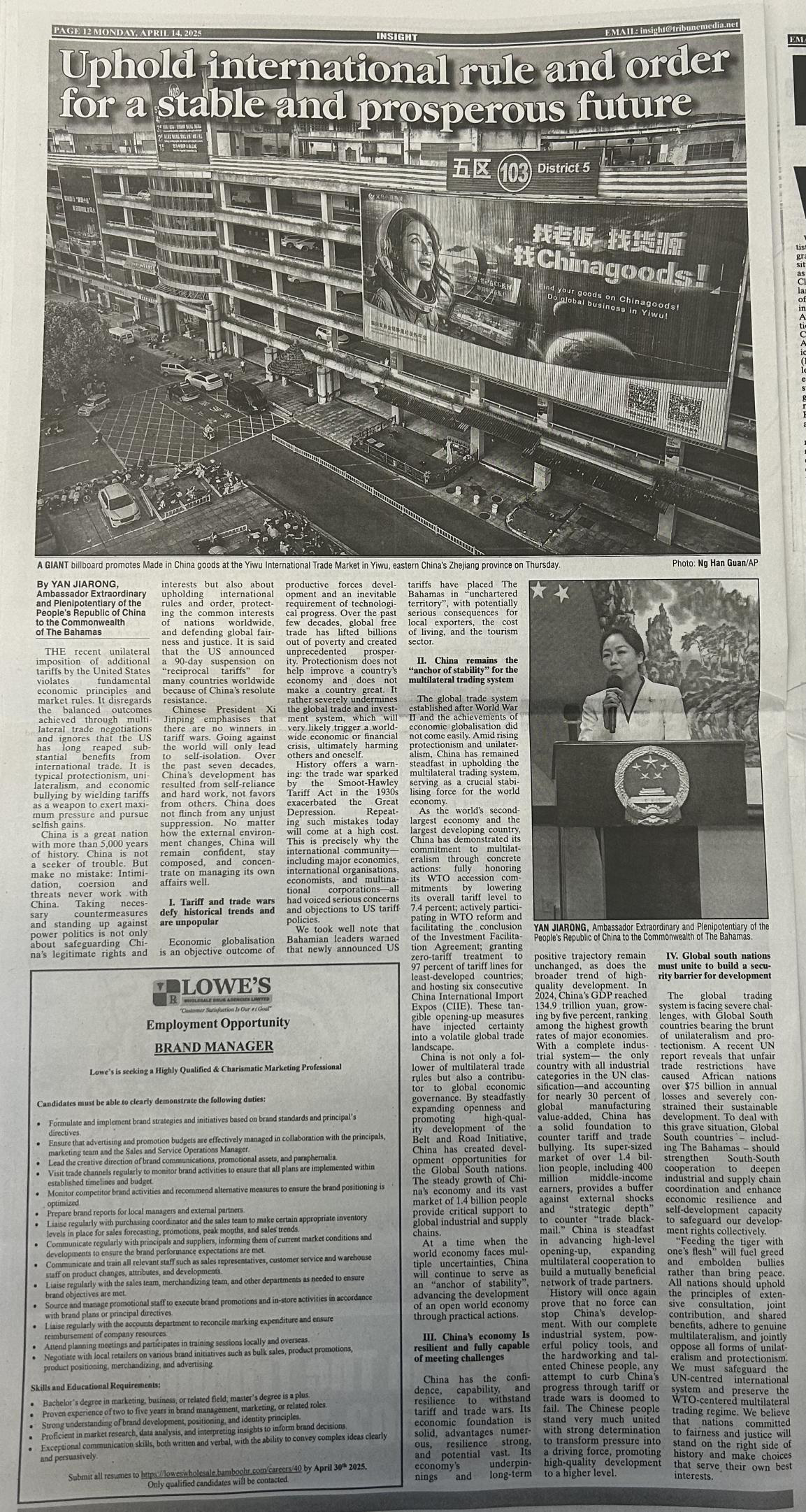
Uphold International Rule and Order for a Stable
and Prosperous Future
The recent unilateral imposition of additional tariffs by the United States violates fundamental economic principles and market rules. It disregards the balanced outcomes achieved through multilateral trade negotiations and ignores that the U.S. has long reaped substantial benefits from international trade. It is typical protectionism, unilateralism, and economic bullying by wielding tariffs as a weapon to exert maximum pressure and pursue selfish gains.
China is a great nation with more than 5 thousand years of history. China is not a seeker of trouble. But make no mistake: Intimidation, coercion and threats never work with China. Taking necessary countermeasures and standing up against power politics is not only about safeguarding China's legitimate rights and interests but also about upholding international rules and order, protecting the common interests of nations worldwide, and defending global fairness and justice. It is said that the U.S. announced a 90-day suspension on “reciprocal tariffs” for many countries worldwide because of China's resolute resistance.
Chinese President Xi Jinping emphasizes that there are no winners in tariff wars. Going against the world will only lead to self-isolation. Over the past seven decades, China's development has resulted from self-reliance and hard work, not favors from others. China does not flinch from any unjust suppression. No matter how the external environment changes, China will remain confident, stay composed, and concentrate on managing its own affairs well.
I. Tariff and Trade Wars Defy Historical Trends and Are Unpopular
Economic globalization is an objective outcome of productive forces development and an inevitable requirement of technological progress. Over the past few decades, global free trade has lifted billions out of poverty and created unprecedented prosperity. Protectionism does not help improve a country’s economy and does not make a country great. It rather severely undermines the global trade and investment system, whichwill very likely trigger a worldwide economic or financial crisis, ultimately harming others and oneself.
History offers a warning: the trade war sparked by theSmoot-Hawley Tariff Act in the 1930s exacerbated the Great Depression.Repeating such mistakes today will come at a high cost. This is precisely why the international community—including major economies, international organizations, economists, and multinational corporations—all had voiced serious concerns and objections to U.S. tariff policies.
We took well note that Bahamian leaders warned that newly announced US tariffs have placed The Bahamas in“unchartered territory”, with potentially serious consequences for local exporters, the cost of living, and the tourism sector.
II. China Remains the "Anchor of Stability" for the Multilateral Trading System
The global trade system established after World War II and the achievements of economic globalization did not come easily. Amid rising protectionism and unilateralism, China has remained steadfast in upholding the multilateral trading system, serving as a crucial stabilizing force for the world economy.
As the world’s second-largest economy and the largest developing country, China has demonstrated its commitment to multilateralism through concrete actions: fully honoring its WTO accession commitments by lowering its overall tariff level to 7.4%; actively participating in WTO reform and facilitating the conclusion of the Investment Facilitation Agreement; granting zero-tariff treatment to 97% of tariff lines for least-developed countries; and hosting seven consecutive China International Import Expos (CIIE). These tangible opening-up measures have injected certainty into a volatile global trade landscape.
China is not only a follower of multilateral trade rules but also a contributor to global economic governance. By steadfastly expanding openness and promoting high-quality development of the Belt and Road Initiative, China has created development opportunities for the Global South nations. The steady growth of China’s economy and its vast market of 1.4 billion people provide critical support to global industrial and supply chains.
At a time when the world economy faces multiple uncertainties, China will continue to serve as an "anchor of stability," advancing the development of an open world economy through practical actions.
III. China’s Economy Is Resilient and Fully Capable of Meeting Challenges
China has the confidence, capability, and resilience to withstand tariff and trade wars. Its economic foundation is solid, advantages numerous, resilience strong, and potential vast. Its economy's underpinnings and long-term positive trajectory remain unchanged, as does the broader trend of high-quality development. In 2024, China’s GDP reached 134.9 trillion yuan, growing by 5%, ranking among the highest growth rates of major economies. With a complete industrial system— the only country with all industrial categories in the UN classification—and accounting for nearly 30% of global manufacturing value-added, China has a solid foundation to counter tariff and trade bullying. Its super-sized market of over 1.4 billion people, including 400 million middle-income earners, provides a buffer against external shocks and "strategic depth" to counter "trade blackmail." China is steadfast in advancing high-level opening-up, expanding multilateral cooperation to build a mutually beneficial network of trade partners.
History will once again prove that no force can stop China's development. With our complete industrial system, powerful policy tools, and the hardworking and talented Chinese people, any attempt to curb China's progress through tariff or trade wars is doomed to fail. The Chinese people stand very much united with strong determination to transform pressure into a driving force, promoting high-quality development to a higher level.
IV. Global South Nations Must Unite to Build a Security Barrier for Development
The global trading system is facing severe challenges, with Global South countries bearing the brunt of unilateralism and protectionism. A recent UN report reveals that unfair trade restrictions have causedAfrican nations over $75 billion in annual losses and severely constrained their sustainable development. To deal with this grave situation, Global South countries – including The Bahamas – should strengthen South-South cooperation to deepen industrial and supply chain coordination and enhance economic resilience and self-development capacity to safeguard our development rights collectively.
"Feeding the tiger with one's flesh" will fuel greed and embolden bullies rather than bring peace. All nations should uphold the principles of extensive consultation, joint contribution, and shared benefits, adhere to genuine multilateralism, and jointly oppose all forms of unilateralism and protectionism. We must safeguard the UN-centered international system and preserve the WTO-centered multilateral trading regime. We believe that nations committed to fairness and justice will stand on the right side of history and make choices that serve their own best interests.